

Gifts for Kids Who… A Brain-Body Gift Guide for Sensitive, Active, and Big-Feeling Kids
Overview
This brain and body gift guide is designed for real-life kids who can’t sit still, get overwhelmed easily, think in patterns, feel everything BIG, or climb nonstop. Instead of age-based toy lists, this guide explains how each gift can support regulation for some kids. Curated by a parent who has quite literally tried everything, these recommendations are sensory-smart, regulation-friendly, and rooted in everyday brain-body science.
Before we get into the actual gift ideas, a small confession:
as I was putting this list together, I realized I have, at some point, owned every single one of these items. Some were bought intentionally, some were gifts, some were parent-to-parent hand-me-downs… and some just mysteriously appeared in my home the way kid stuff does.
And honestly? It was a moment of reflection. Like, how did I end up with an entire sensory gym, half an engineering lab, and a small emotional regulation toolkit in my living room? If you’re nodding right now, hi. We’re the same kind of parent.
But the wild part is: I didn’t collect these things randomly.
I collected them because I was slowly learning how my child’s brain and body process the world - what overwhelmed him, what grounded him, what helped him make sense of big feelings or big movement or big ideas.
And that’s really the magic of this list.
It’s not a toy roundup.
It’s a reflection of all the little patterns we notice as parents. The “ohhh, this helps him settle,” or “yep, she needs to climb before she can think,” or “that squishy thing has basically saved dinner time.”
These are gifts that actually support the nervous system underneath the behaviors.
And because I’ve tried (or tripped over) most of them myself, this list is truly curated with lived experience and a whole lot of brain-body nerdiness.
(Affiliate note: Some links may be Amazon affiliate links, which means I may earn a small commission at no cost to you. You never have to use them — they’re here for ease and to save you from having to Google what something is.)
Gifts for Kids Who...
...Can’t Sit Still
These kids aren’t “hyper.” Their proprioceptive and vestibular systems may crave movement to organize the brain. When they move, their nervous system settles.
Great gift options:
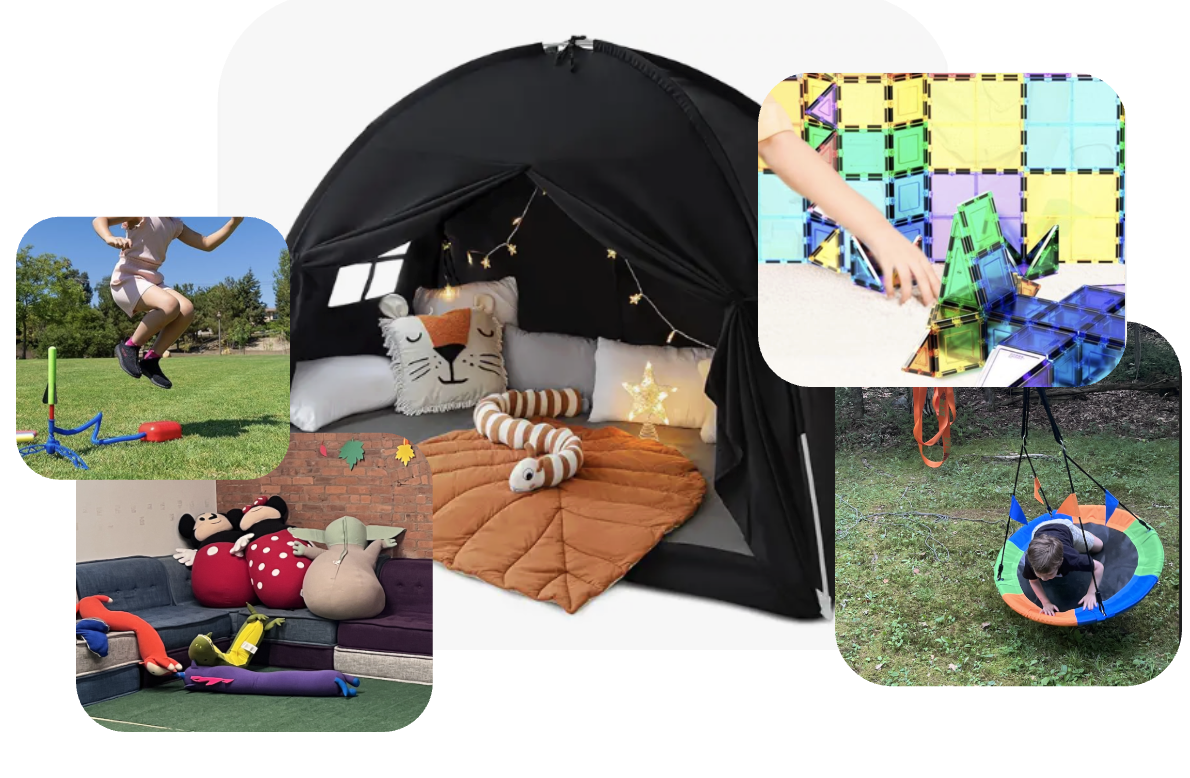
- Wobble cushion — gives micro-movement that helps attention
- Stomp rocket — provides heavy work + joyful impact
- Mini trampoline — repetitive movement = regulation
- Scooter board — full-body proprioceptive input
- Agility dots or floor markers — structured movement patterns
- Hopper ball — rhythmic bouncing resets arousal
Why these help:
Movement supports attention, body awareness, and motor planning. For many kids, motion is regulation.
... Get Overwhelmed Easily
These kids experience the world with heightened sensory sensitivity. Holiday noise, lights, crowds, and transitions can overload their system quickly.
Great gift options:
- Cozy tent or canopy — instant “micro retreat”
- Weighted buddy or lap pad — grounding deep pressure
- Dimmable lamp / warm lights — gentler visual environment
- Noise-reducing earmuffs — softens layered sound
- Soft textured blanket — tactile comfort
- Calming glitter tube or slow sensory timer — visual predictability
Why these help:
Reducing sensory load creates safety cues for the nervous system, helping kids reset when the world gets too loud or fast.
... Love to Build + Take Things Apart
These kids are pattern-makers with fast, detailed brains. They thrive on building systems, solving problems, and seeing how things work.
Great gift options:
- Magnetic tiles — open-ended pattern construction
- Marble run — cause-and-effect + sequencing
- Snap Circuits — early engineering logic
- Gear-building kits — how parts work together
- Block sets with varied shapes — design + creativity
- Screwdriver/tinker kits — safe deconstruction play
Why these help:
Kids who think in systems regulate through problem solving. Building engages working memory, motor planning, and structure — all things their brains love.
... Feel Everything BIG
These children process emotions intensely. Their emotional system is highly attuned — which means they need tools that move feelings through the body, not tools that quiet them.
Great gift options:
- Stretchy resistance band — physical outlet during overwhelm
- Squishable pillows or plush — grounding pressure
- Kids’ journal with visual prompts — expression without pressure
- Emotion cards — supports naming + noticing
- Kinetic sand or putty — sensory regulation through hands
- Weighted plush — comfort + co-regulation
Why these help:
Emotions are a body-based process. These tools help children externalize, express, and regulate without shame or shutdown.
... Are Always Climbing
These seekers crave vestibular (movement) and proprioceptive (pressure) input to feel grounded in their body. Climbing helps them find where they are in space.
Great gift options:
- Indoor climbing holds — safe vertical movement
- Nugget/foam play couch — endless configurations
- Stepping stones — balance + motor planning
- Doorway pull-up/monkey bar set — upper body heavy work
- Sensory swing (lycra or pod swing) — deep vestibular input
- Crash pad — safe landings + proprioceptive feedback
Why these help:
The vestibular system supports attention, coordination, emotional regulation, and body confidence. When these kids climb, they’re organizing their brain.
If you read through this list and thought,
“Wait… do I already own half of these?”
You are in very good company.
Most of us didn’t set out to build a small sensory gym or an emotional regulation starter pack. It just sort of happened as we learned how our kid’s brain and body work. One wobble cushion becomes three, a single weighted buddy turns into a whole cozy corner… and suddenly you’re like, “Oh wow, I live in a proprioceptive wonderland.”
But honestly? That’s the heart of it.
These gifts aren’t about buying more stuff.
They’re about noticing what actually supports your child — what helps them feel grounded, safe, curious, connected.
And once you start seeing those patterns, their whole world makes a lot more sense.
Whether you grab one thing, nothing at all, or accidentally build a mini climbing studio in your living room (hi, it me), I hope this guide helps you understand why certain tools feel like magic for your child’s nervous system.
And if you want help making sense of those everyday patterns — the big feelings, the movement bursts, the sensory overloads, the quiet retreats — the free Brain and Body Foundations Guide linked here.
It’s the starting point I wish I had before discovering I apparently own every sensory item known to humankind.
Welcome to the club.
We have snacks. And stepping stones.
So many stepping stones.