

Why Small Things Feel So Big for Some Kids
Overview
For some kids, a small thing (sock, cup, "two more minutes") triggers a big reaction not because of the thing itself, but because the kid's daily capacity for handling stuff is already spent down — same trigger costs almost nothing in the morning, costs everything by late afternoon. The reaction isn't the start of the story, it's the end of it.
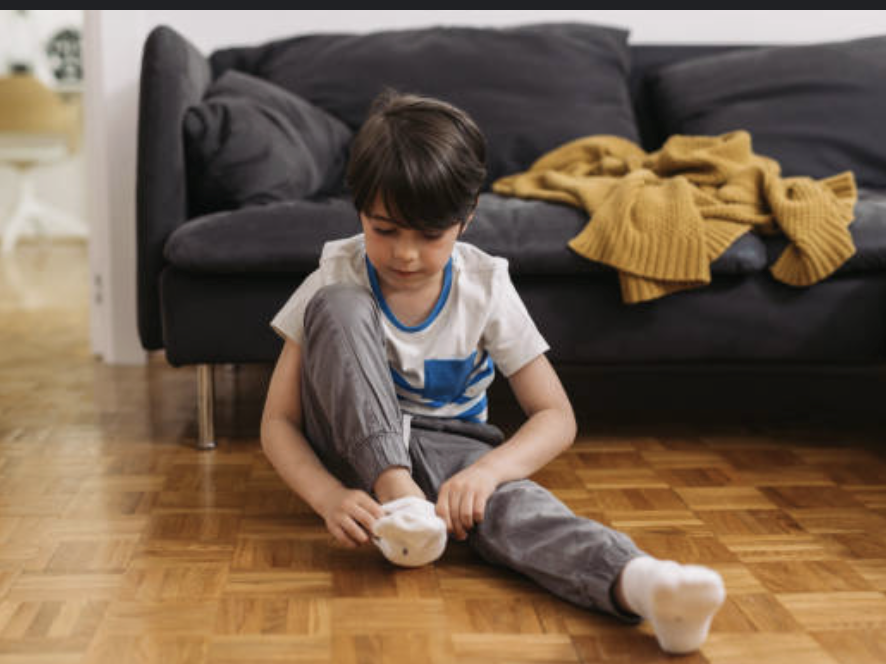
The socks have to have the seam flat under their toes, or they're coming right back off.
"Two more minutes" — said three times, tablet still in hand.
Pushed away the green cup. Has to be the blue one. With the straw.
From where you're standing, none of this is a big deal. A sock. A cup. A countdown. You've explained, you've negotiated, you've offered the other cup, and somehow it's now a whole thing.
But it’s about everything that happened before and the sock just happened to be what finally tipped things over.
Think of It Like a Budget, Not a Switch
Every kid starts the day with a certain amount of capacity for handling stuff — sensory input, transitions, "no," waiting, surprises, big feelings. Every one of those things costs a little something. None of them are expensive on their own. But there's no pause button. The spending is constant, all day, starting from the second they wake up.
And the same thing doesn't always cost the same amount. A scratchy sock at 9am might cost almost nothing. There's plenty in the tank, easy to shrug off. The exact same sock at 4pm, after a full day of school, transitions, and trying to keep it together? Suddenly it costs everything that's left. Not because the sock changed. Because the tank did.
So when your kid is fine with something on Tuesday and falls apart over the identical thing on Thursday? That's the capacity balance being different.
Why It Looks Like It Comes Out of Nowhere
There's no gradual fade-out. The brain doesn't slowly get "a little less okay" and then "a little less than that." It runs fine, runs fine, runs fine and then it doesn't. All at once.
That's because the part of the brain doing all this managing — staying flexible, handling the unexpected, not reacting to every little thing — has a floor. When it hits that floor, it doesn't ease up gracefully. A faster, much older part of the brain takes over instead. It’s the part whose only job is "threat or no threat," with zero interest in nuance and absolutely no patience for "we talked about this."
That's the cliff. The spending was gradual. The drop-off wasn't.
When the Plan Changes, the Cost Goes Up
There's one more thing that makes certain moments hit harder than they "should": when something doesn't go the way it was supposed to.
Kids run on a kind of internal forecast — here's what's coming next. When the forecast is right, that costs basically nothing. When it's wrong — wrong cup, skipped step in the bedtime routine, "wait, what did you say?" for the third time — the brain has to process two things at once: the actual thing, and the fact that the plan just didn't hold. That second part is its own cost, on top of the first. It's not "the cup costs something." It's "the cup costs something, plus the surprise of it not being the right cup," and that second charge is often the bigger one.
This is why a kid can watch their tower fall, knock it down themselves, and walk to the couch without a word — and it's not about the tower. It's the forecast (I'm building this) not matching reality (it's on the floor now), landing on a system that didn't have much left to give.
What This Means for the Moment You're In
None of this means anything is broken. It means the moment you're seeing is the end of something, not the start of it — and the actual lever isn't the sock, the cup, or the tower. It's everything that happened before you ever saw any of those things.
That's good news, actually. It means you're not stuck debugging "why does she care so much about cup color." You're looking at the balance for the day and there's a lot more you can do with that than with cup color.
If this is your kid: you're not imagining it, and the sock really isn't the point. Their system has been working hard all day, quietly, long before you ever saw it run out. If you want a clearer way to understand what's actually being spent — and where — the free resources are a good place to start.